
Some fans arrive in front of thousands of people, under television lights and with the whole football world watching. Others are much smaller: a first visit to Gander Green Lane, a child being brought along by a parent, a supporter deciding that their local club means more to them than the team they once followed from a distance.
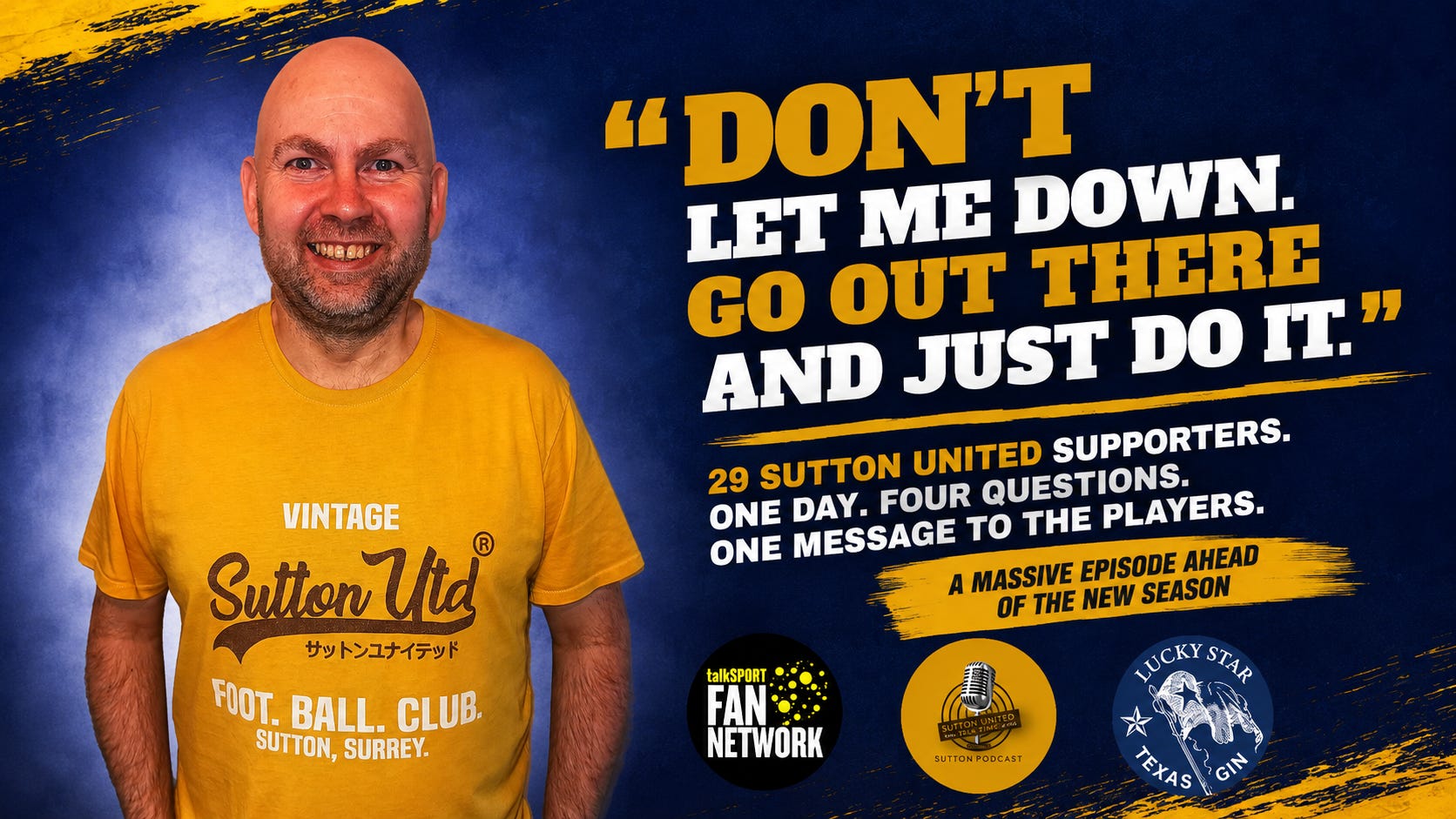
The latest episode of the Sutton United Talk Time on Podcast manages to capture both sides of that story. It began with something new for the season ahead, as I sat down with Ben from Play Nimbus to introduce the Sutton Podcast Play Nimbus League. It then developed into something far bigger than originally planned, as 29 people at the final friendly of pre-season answered questions about why they support Sutton United, what they expect from the coming campaign and what message they would send to the players.
The result is an episode about fantasy football, predictions, new signings, old memories and, most importantly, the different ways people find their way to Sutton United.
What is Play Nimbus?
Fantasy football has become a regular part of the modern game, but most versions follow the same familiar pattern. You select a squad before the season begins, manage transfers over several months and hope you remain interested long enough to reach the final weekend.
That format works for millions of people, but it also has obvious limitations. A poor start can leave you well behind by October, while supporters of clubs outside the Premier League or EFL can find themselves selecting players they watch on television rather than those representing the club they follow every week.
Play Nimbus has been created as an alternative. Instead of managing one team for an entire season, users can play game by game and week by week. Sutton supporters can build a team around each Sutton United fixture, while still having access to matches from more than 130 leagues and competitions around the world.
That short-form approach is the biggest difference. Missing one weekend does not ruin your season, and a bad result does not leave you trapped near the bottom of a table for the next nine months. Each fixture is a new contest and a fresh opportunity to prove that you know more about football than everyone else.
Or, in my case, to discover how many people know more than I do.
How the game works
The basic idea is simple. For each fixture, users select four or five players, including a goalkeeper, defender, midfielder and attacker. There is also the option to double up with a captain or select a fifth wildcard player from any position.
The important twist is that you cannot fill the entire team with Sutton players. At least two selections must come from each side.
When I first heard that rule, my immediate reaction was that I did not know enough about the opposition. That, however, is precisely the point. If every Sutton supporter simply selected the same four Sutton players each week, most teams would look identical and there would be very little genuine decision-making involved.
Forcing users to select players from both teams creates jeopardy. It encourages a little more research, makes the opposition relevant and ensures that even supporters competing in the same private league are likely to build very different teams. Play Nimbus has already been tested with groups of 30 or 40 people, and Ben explained that identical selections have remained surprisingly rare.
That adds another dimension to matchday. You are still hoping Sutton win, of course, but you might also find yourself noticing how many saves the opposition goalkeeper has made, whether one of their midfielders is creating chances or which defender is winning the most tackles.
More than goals and assists
One of the most interesting parts of Play Nimbus is the scoring system. It does not simply reward the players who score goals or provide the final pass.
Goalkeepers receive points for saves. Defenders are rewarded for tackles. Midfielders gain points for key passes, recognising the moments that create danger even if they do not result in a direct assist.
Attackers can also lose points through inefficiency. A striker who keeps shooting without scoring may find their total reduced, meaning users need to consider whether they are selecting a clinical finisher or simply someone likely to take a large number of hopeful shots.
That feels particularly suitable for lower-league football, where supporters often appreciate performances that cannot be understood simply by checking the final score or reading the list of goalscorers. A goalkeeper making eight saves, a defender winning everything in the air or a midfielder controlling the game can be just as important as the player who eventually puts the ball in the net.
Built around matchday
Teams can be changed until five minutes before kick-off, allowing users to react once the official line-ups have been announced. That gives supporters travelling to matches enough time to make changes at the ground rather than having to predict the team several hours earlier.
There is also an automatic substitution system. If someone misses the line-up announcement or selects a player who does not start, Play Nimbus will replace them with an available player in the same position.
We saw during the World Cup testing why that mattered. One participant was rather unhappy when a player they had selected started on the bench, later came on and scored, yet had already been replaced by the automatic substitution system. The simple answer was that the player had not started, which was the rule, and therefore there was not much point arguing with me about it.
The World Cup trial also demonstrated that even a relatively simple game can become a bit much when the person running the league ignores advice and creates a new contest for almost every day of the tournament. Lessons were learned. This season the plan is to focus on Sutton fixtures, recognise the weekly winners and, most importantly, compare everybody’s performance with mine.
A global game with a local focus
The Sutton Podcast league will naturally centre on Sutton United, but Play Nimbus is not restricted to a single club or competition. Users can enter private leagues, join wider Play Nimbus challenges or create leagues of their own.
The available matches stretch from the Champions League and Europa League to international tournaments, National League North and National League South. When Sutton are not playing, there is usually another fixture somewhere that can be used for a quick competition.
The platform also updates points during matches. Goals and other match data are fed into the app so users can watch the leaderboard change while the game is taking place. Ben was careful not to promise that every update would arrive at exactly the same speed across every level of football, but explained that the system can sometimes receive goals and confirmed line-ups before several well-known live score services.
Naturally, I asked whether the administrator of a private league could make manual adjustments and perhaps award himself a few additional points when necessary.
Unfortunately, no.
Ben did explain that genuine data errors can be reported and corrected, but league organisers are not permitted to quietly improve their own scores. This is probably better for the integrity of the competition, although less useful for me personally.
From fantasy football to real supporters
The Play Nimbus conversation introduced something new for the coming season, but the second half of the episode captured something much more familiar about Sutton United.
Rather than recording a traditional season preview with two or three guests, I took a microphone to the final friendly and asked supporters a few simple questions. The original plan was to speak to perhaps ten or so people. I eventually came away with 29 contributors, including supporters of different ages and backgrounds, a couple of players, the manager and a former player watching from the stands.
It created an editing job I would not necessarily recommend repeating in exactly the same way, but the answers were worth it.
Why Sutton United?
The first question was intended to be straightforward: give your name and explain why you support Sutton United.
In practice, possibly because of the weather and possibly because of the Cruzcampo, the wording changed occasionally to how long people had supported Sutton. Even so, the answers produced a wonderful collection of stories.
Some had supported the club for most of their lives. Neil had been brought along by his father as a five-year-old, 66 years earlier. David Smart had spent more than four decades around Sutton as a supporter, ball boy, steward and player for the youth and reserve teams. Julian had been coming since his mother first brought him at the age of eight.
Others had arrived much more recently. Ross had been attending for two or three seasons after deciding that local football offered something different from following Chelsea. Arthur came from a Manchester City-supporting family but found that going regularly to a local club with friends gradually changed the relationship. As he explained, there came a point when Sutton “had” him and he began to care properly.
Several people had been introduced by parents, relatives or friends. Andrew first came through someone connected with his Scout unit. Matt brought his son to a match, watched Sutton win 5-0 and admitted that they had both become slightly obsessed. Joe Potter had attended with his father and brother, while Darren now brings his own son after 35 years of following the club himself.
There were also routes into the club that would not have existed a generation ago. Joe C first developed a greater interest through a Sutton career mode on FIFA 22, having already watched non-league football online and followed the FA Cup tie against Arsenal. He now works for the club, describing that as his dream.
Children offered equally direct answers. Sutton were an amazing team, a local club, a good community and simply a fun place to be. One supported the club because an aunt worked there, another because they played for Sutton themselves.
The reasons were different, but there was a familiar pattern. People arrived through family, geography, curiosity, friendship, computer games or chance, then found themselves becoming part of the club.
What can Sutton achieve?
Pre-season predictions always contain a mixture of optimism and caution, and the 29 answers were no different.
Promotion and the play-offs dominated the conversation. Some went straight for first place, while others tried to separate their optimistic prediction from their realistic one. A top-half finish was considered acceptable by some, but the general feeling was that Sutton should at least be capable of challenging around the play-off positions.
There were reasons behind that confidence. Several people referred to the strength and physical profile of the squad, with one supporter describing Sutton as having one of the best midfields in the league. The team looked fitter and more athletic than in recent seasons, while the recruitment appeared to match the qualities the manager had publicly said he wanted.
There was also caution. Fitness was mentioned repeatedly, with supporters clearly remembering how damaging injuries had been. Others simply wanted visible progress after a difficult campaign, whether that meant a top-ten finish, a stronger defensive record or a decent run in the FA Cup or FA Trophy.
David Smart went beyond the league table and suggested reaching the fourth round of the FA Cup to generate money for the club, alongside another possible trip to Wembley in the FA Trophy.
Sarah, meanwhile, spotted the obvious loophole in the question. I had asked for a prediction for the season but had not specifically demanded a league position. Her prediction was that she would attend every match and complain about half-and-half scarves.
It may prove to be the safest prediction of the entire episode.
Who will collect the Man of the Match awards?
Supporters were also asked which player they expected to win the most Man of the Match awards during the season.
Charlie Carter was the clearest favourite. His ability to contribute goals and assists from midfield, influence games and grab them “by the scruff of the neck” made him a popular choice.
Temi Babalola also received plenty of support, particularly from those expecting the new striker to score regularly. Charlie Bell’s energy, commitment and old-fashioned approach had already caught the eye during pre-season, although more than one person added the condition that he would need to stay on the pitch and avoid flying into quite so many challenges.
Dan Urpen was backed after an impressive pre-season, while Manny Osadebe and Jake Taylor were recognised for the less glamorous work that can decide matches. Goalkeeper Spike also received a vote from Sarah, partly because of his dramatic and sometimes possibly unnecessary acrobatic saves.
The range of answers was encouraging. Supporters were not relying on one obvious star or one established name. Different players had already impressed different people, suggesting there are several potential match-winners within the squad.
A message to the players
The final question asked each contributor what message they would send to the players before the season began.
The answers ranged from detailed tactical instructions to the admirably simple “stop pulling shirts, please”, but several themes appeared repeatedly.
Supporters want the team to play with pace, power and purpose. They want Sutton to put opponents under pressure, move forward and become, as Chris Agutter put it, the opposition’s worst weekend.
They also want discipline. The red and yellow cards from last season have not been forgotten, and several contributors specifically asked the players to keep their heads and make sure Sutton still had 11 men on the pitch at the final whistle.
Most of all, however, supporters asked for effort. Play for the shirt. Wear the badge with pride. Give everything. Fight for the fans. Leave it all on the pitch.
Darren explained that wearing chocolate and amber means something to the people watching. Supporters would back the players, but in return they wanted to see the same commitment from those representing the club.
Others recognised that every season contains good and bad moments. Jake Taylor advised the squad to enjoy both the highs and lows without getting carried away by either. Julian’s message was that if the players gave 100 per cent, the supporters could not reasonably ask for anything more.
The youngest contributors offered equally important advice: work hard, score goals, avoid fights and, if possible, produce the occasional bicycle kick.
Sarah finished with perhaps the most honest message of all. She had watched the entire pre-season, loved what she had seen and was genuinely excited about what the team might achieve.
“Don’t let me down. Go out there and just do it.”