
An opening-day test of whether Sutton’s defensive rebuild can turn possession into genuine control.
Match details
Competition: Enterprise National League,
Matchday: One
Date: Saturday 8 August 2026
Kick-off: 3pm
Venue Away at Laithwaite Community Stadium

A new season, but a familiar question
Sutton begin the season with a squad that appears better equipped to handle the National League’s physical and tactical demands. Woking provide an immediate test of whether that improvement is merely visible on the team sheet or already functioning on the pitch.
The central issue is not whether Sutton can have possession. They averaged more of it than Woking last season. The question is whether they can use the ball without leaving themselves vulnerable when it is lost.
Woking have recruited pace, direct running and individual attacking ability. Their change of manager during pre-season makes the precise system difficult to predict, but the threat is relatively clear: invite Sutton forward, regain possession and attack the spaces left behind.
This is therefore an early examination of Sutton’s rebuilt defensive structure, particularly the protection around the centre-backs when the full-backs advance.
Fixture at a glance
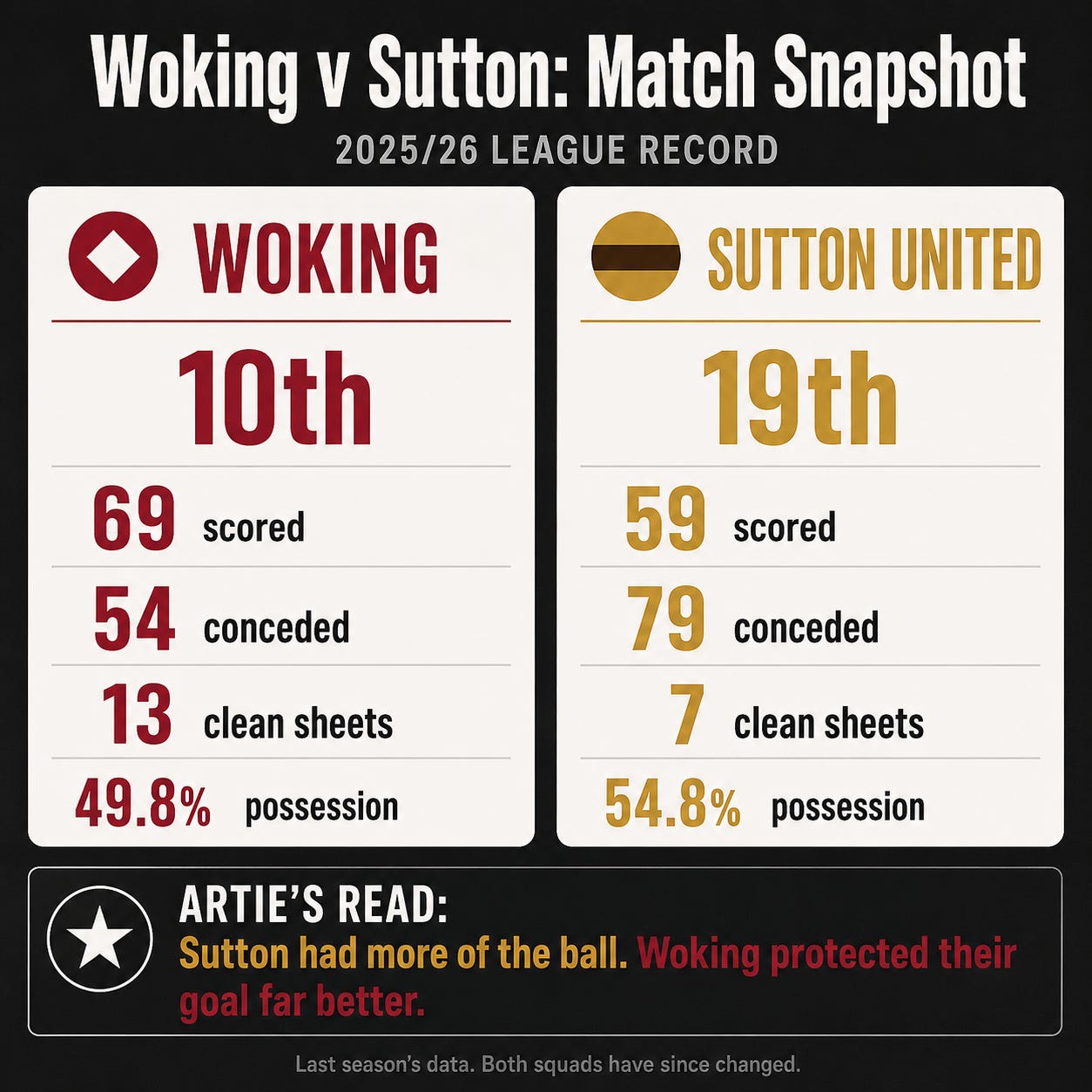
The difference requiring no great scouting computer to identify is at the back. Woking conceded 25 fewer league goals and kept nearly twice as many clean sheets.
Sutton’s greater possession and slightly higher passing accuracy did not automatically produce control. A team can complete plenty of passes and still find itself sprinting towards its own goal after one poor turnover. Sutton did that too frequently last season.
There is, however, an important warning attached to every figure above. These numbers describe the 2025/26 versions of the two teams. Both squads have changed and Sutton’s recruitment has been deliberately aimed at correcting their defensive weakness.
What has changed?
Woking’s uncertainty begins in the dugout
Jermain Defoe left Woking during pre-season after less than four months in charge. Craig Ross and Jake Hyde subsequently took interim control, having also overseen Woking’s strong finish before Defoe’s appointment.
That gives Woking some continuity, but it leaves uncertainty over how much of Defoe’s intended system will survive. The interim staff may favour a straightforward opening-day plan built around defensive security and quick attacks rather than attempting anything unnecessarily elaborate.
In short, Woking are less predictable than they might otherwise have been. That does not necessarily mean less organised.
Sutton have rebuilt the spine
Sutton’s most significant summer work has taken place through the centre of the pitch.
Will Nightingale and Jordan Moore-Taylor bring defensive experience, while Alex Kirk returns after his long-term injury. Kwaku Donkor adds another defensive option and Spike Brits has increased competition in goal.
Further forward, Emmanuel Osadebe and Charlie Carter add experience and physical capacity to midfield. Temi Babalola gives Sutton a central striker capable of occupying defenders, while Sam Folarin supplies the pace needed to exploit the spaces around him.
The recruitment appears designed to give Chris Agutter more ways of winning a match. Sutton can still build through possession, but they should now be able to play forward earlier, contest direct balls and present a much greater aerial threat.
Recent evidence
Pre-season results require careful handling. Teams make wholesale substitutions, use trialists, alter training loads and sometimes choose stronger opponents precisely because losing provides a useful examination.
The results offer clues, not proof.
Sutton United
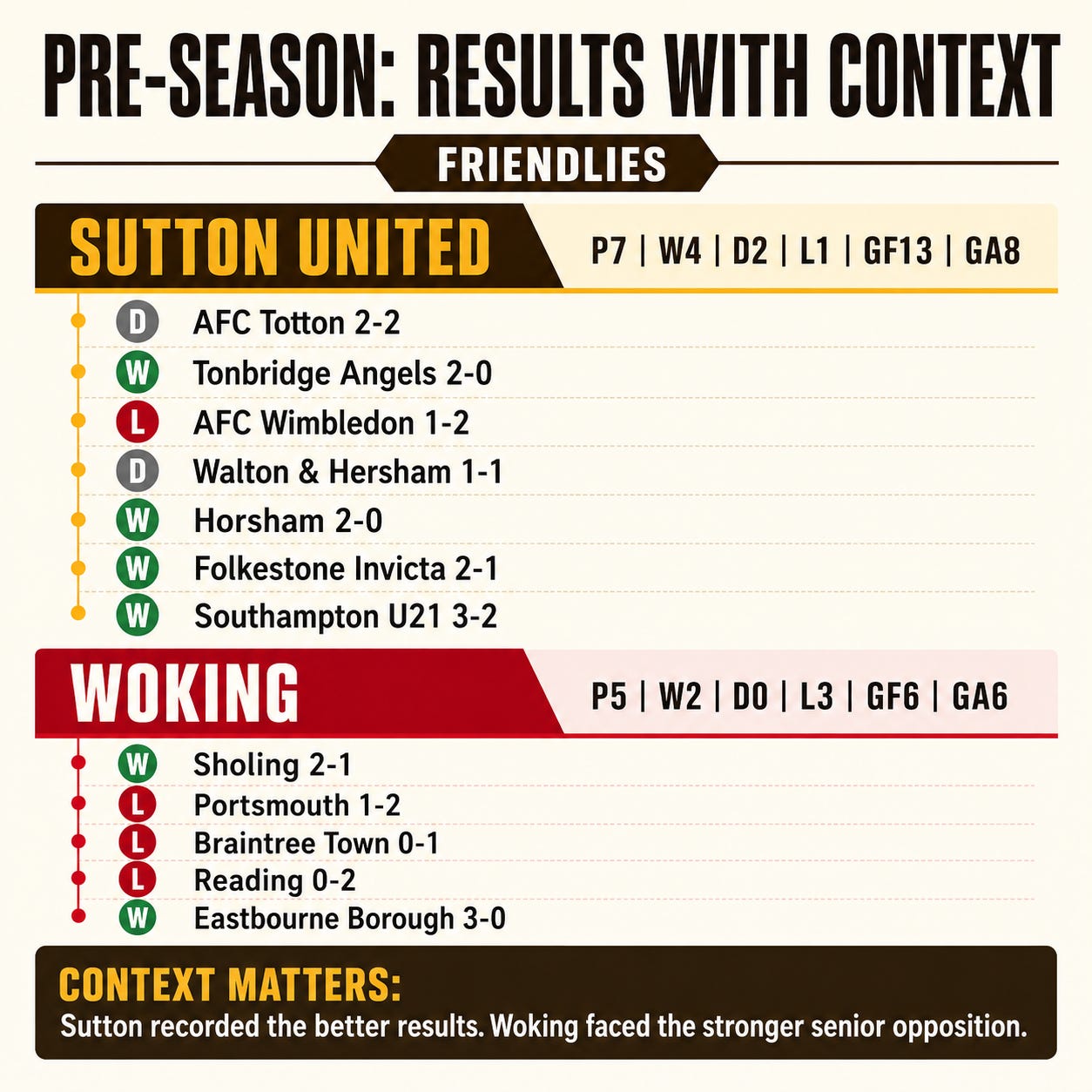
The record is encouraging, although five opponents were either below National League level or an academy side.
The narrow defeat against League One AFC Wimbledon may consequently tell us more than some of the victories. Sutton led through Babalola and remained competitive until conceding twice late in the match.
The final friendly against Southampton U21 provided the clearest indication of Sutton’s attacking tools. Two Dan Urpens long throws produced goals for Alex Kirk and Will Nightingale, while Folarin used his pace to get behind the defence for the third. Sutton also pressed aggressively, with Folarin twice regaining possession high up the pitch. The official Sutton report confirms the decisive role of Urpens’ throws.
Woking
Three defeats can look untidy until the opposition is considered. Portsmouth and Reading represented considerably stronger tests, and Woking remained competitive for long periods in both games.
The 3-0 win at Eastbourne was a positive conclusion. Sean Adarkwa, Taylan Harris and Josh Ayres scored after half-time, suggesting Woking retained attacking threat as the match opened up.
How Woking may play
This section necessarily involves inference. A mid-pre-season managerial departure does not make tactical forecasting especially tidy.
Shape
Recent selections indicate that Woking can operate with a back three or a flexible back five. Zico Asare and Matt Ward are among the players capable of supplying width, although their positioning may depend on how cautious the interim staff choose to be.
A more conservative system would allow Woking to protect the middle, leave Sutton’s centre-backs in possession and wait for a suitable pressing trigger.
Build-up
Woking possess technically capable central midfielders, including Harrison Sohna, Jake Forster-Caskey, Roy Syla and Tim Akinola. They should therefore be comfortable attempting to play through pressure when the opportunity is there.
They may not insist on doing it, however. If Sutton commit Babalola and Folarin to the press, Woking can bypass that first line and compete for territory instead.
Pressing
The likely approach is selective rather than relentlessly aggressive.
A pass towards the touchline, a poor first touch or a backwards ball to a defender could provide the trigger. Woking’s quick attackers are well suited to turning a regain into an immediate forward movement.
Attacking routes
The principal threat is likely to come from transition:
Find Josh Kelly or Aiden O’Brien between the lines.
Release Taylan Harris or Ashley Clarke into wide spaces.
Use Sean Adarkwa as the central reference point.
Create crossing opportunities before Sutton can reset.
Clarke recorded 11 goals and ten assists while on loan at AFC Totton last season. The level must be acknowledged, but that output still demonstrates a player capable of turning one-against-one situations into goals.
Defensive transitions
If Woking use adventurous wing-backs, space can appear outside their centre-backs. That is where Folarin’s movement could become especially valuable.
The trade-off for Woking is simple. Push the wide players forward and they can expose Sutton’s full-backs. Leave them too high when possession changes and Sutton have a direct route into the channels.
Set pieces
Sohna provides left-footed delivery and a shooting threat from central free-kicks.
Woking will also need a specific plan for Urpens’ long throw. Any Sutton throw within range of the penalty area may effectively become an attacking set piece.
How Sutton may approach it
Sutton’s final friendly suggested a structure resembling a 4-2-2-2, with Jake Taylor and Osadebe anchoring midfield, Charlie Bell and Noah Nzuzi ahead of them, and Babalola partnered by Folarin.
That is evidence from one friendly rather than confirmation of Saturday’s formation. Carter and Jermaine Francis offer alternative solutions, particularly if Agutter wants another player capable of carrying the ball through midfield.
Without the ball
Sutton are likely to press Woking’s short build-up with two forwards positioned close to the centre-backs. The purpose is not simply to chase possession. It is to force play into a predictable area where the midfield can compete for the next pass.
The difficulty comes if Woking beat that first pressure. Sutton’s midfield then needs to close around Kelly before he can turn and attack the back line.
With the ball
Controlled possession will remain part of Sutton’s identity, but the new squad appears capable of moving away from sterile circulation.
Babalola provides a target for earlier passes. Folarin can attack the space around the first contact, while Carter or Francis can advance to collect second balls.
That gives Sutton the option to play through Woking or over the first line of pressure. Having both routes matters because becoming too predictable away from home is rarely a brilliant survival strategy.
Width and full-backs
Urpens and Besart Topallaj can advance and support attacks, but the timing of those movements will be crucial. Sending both forward simultaneously would leave Sutton inviting Woking to counter into exactly the spaces their new attackers want.
One full-back holding a little deeper while the other advances may provide a safer balance.
Defensive structure
Taylor’s positioning could be more important than his passing. When Sutton attack, he may need to remain connected to Nightingale and Kirk and block the first forward pass after possession is lost.
That first few seconds after a turnover will reveal whether Sutton’s possession is producing control or merely changing who has the ball.
Three key battles
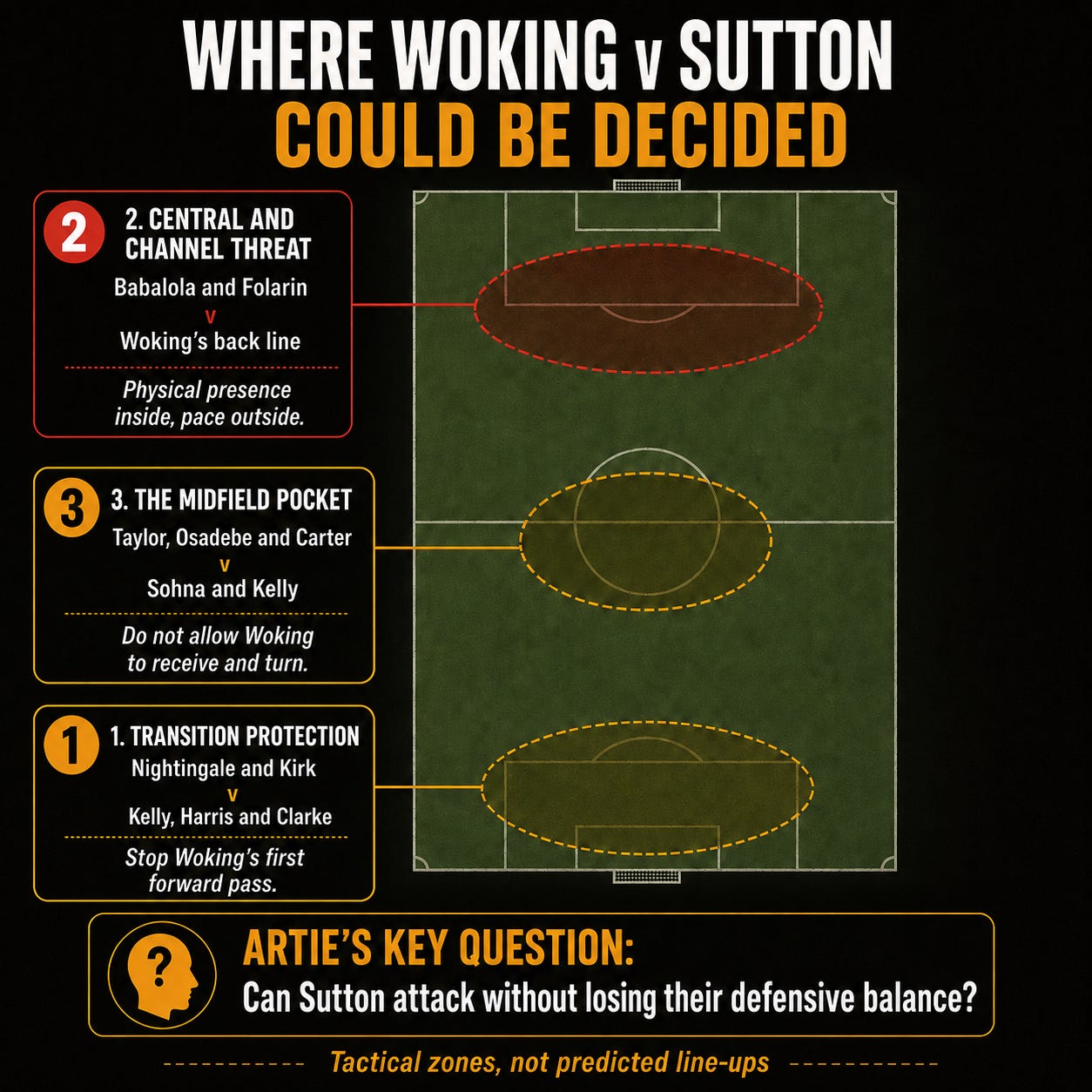
1. Sutton’s protection against Woking’s transitions
Key players: Jake Taylor, Will Nightingale and Alex Kirk against Josh Kelly, Taylan Harris and Ashley Clarke.
Sutton’s greatest risk is losing possession with both full-backs and too many midfielders ahead of the ball. Woking have the pace to turn that moment into an immediate chance.
Taylor must screen the space in front of the centre-backs, while Nightingale and Kirk need to judge whether to step forward or retreat. If they get caught between those decisions, Kelly can receive between the lines and release runners either side.
Sutton’s response should be to keep a stable defensive platform behind attacks, then pressure the first Woking pass immediately after a turnover.
Key question: Can Sutton stop Woking’s first forward pass before the wide runners accelerate?
2. Babalola and Folarin against Woking’s back line
Key players: Temi Babalola and Sam Folarin against Woking’s central defenders and wide defenders.
The pairing presents two different problems. Babalola can occupy defenders, compete for direct passes and secure territory. Folarin can move beyond him into the channels.
If Woking push their wide defenders forward, Folarin should find space outside the centre-backs. If they remain deeper to protect against his speed, Sutton may gain more room in midfield.
Babalola does not necessarily need to dominate the scoring chances to influence the match. Drawing two defenders towards him could create the decisive space for somebody else.
Sutton must avoid leaving him isolated. At least one midfielder needs to remain close enough to compete for knockdowns and second balls.
Key question: Can Sutton turn Babalola’s physical work into forward possession rather than isolated aerial contests?
3. Control of the central pocket
Key players: Taylor, Osadebe and potentially Carter against Sohna, Kelly and Woking’s central midfield.
Woking’s technical quality makes the area between Sutton’s midfield and defence particularly important. Kelly is dangerous when he can receive there and turn towards goal.
Sutton need enough midfield presence to close that space without dropping so deeply that Babalola and Folarin become disconnected from everyone behind them.
Carter could be valuable because he offers a way out under pressure. If he can receive, turn and carry Sutton beyond Woking’s first midfield challenge, the home side will have to retreat rather than prepare their next attack.
Key question: Which team can receive on the half-turn in midfield without immediately being forced backwards?
Three Woking players to watch
Josh Kelly: The connector
Role: Forward capable of playing wide, centrally or behind the striker.
Kelly is arguably Woking’s most proven individual attacking threat at this level. His importance lies in connecting midfield to attack rather than remaining fixed in one position.
He can receive on the half-turn, combine quickly around the box and draw fouls in useful areas. Sutton must prevent him drifting unnoticed into the gap between Taylor and the centre-backs.
Evidence point: Kelly scored five goals in 24 appearances during the first half of last season before suffering an injury on Boxing Day.
What Sutton must stop: His first touch facing forward.
Taylan Harris: The direct runner
Role: Left-footed attacker capable of playing across the forward line.
Harris adds pace and uncertainty. He can attack from either side, which means Sutton’s full-backs cannot assume the threat will remain in one channel.
His value may increase as the match progresses. Whether starting or introduced from the bench, his speed could be particularly dangerous against defenders who have already spent an hour competing physically.
Evidence point: Harris scored on his Woking debut in the 3-0 pre-season victory at Eastbourne Borough.
What Sutton must stop: Allowing him to receive with open grass between himself and the penalty area.
Harrison Sohna: The midfield launch point
Role: Left-footed central midfielder who can play deep or operate as a number eight.
Sohna provides energy, forward movement and set-piece delivery. He may also be central to Woking’s attempts to play through Sutton’s press.
Babalola and Folarin can disrupt the first pass, but Sutton’s midfield must prevent Sohna receiving the next one in space. He is also capable of punishing defenders who retreat too far.
Evidence point: Sohna scored Woking’s pre-season goal against Portsmouth with a long-range strike.
What Sutton must stop: Giving him time to set himself outside the penalty area.
Head-to-head
Sutton are unbeaten across six meetings, winning four. They have also won three and drawn one of their past four competitive visits to Woking.
That record should provide confidence, but not a tactical forecast. Several of the players and managers involved have changed. Historical reassurance is useful. Historical defending is less so.
Sutton’s route to a result
Protect the first pass after losing possession.
Taylor and the centre-backs must prevent Kelly or Sohna receiving freely while Sutton’s shape is stretched.Vary the build-up.
Sutton should play through midfield when Woking leave the route open, but use Babalola earlier when the home press becomes aggressive.Release Folarin into the channels.
His speed can force Woking’s wide defenders backwards and create space for Sutton’s midfield.Keep one full-back connected to the defence.
Advancing Urpens and Topallaj together would make Woking’s transition game considerably easier.Attack second balls around Babalola.
Direct passes only become useful if Carter, Francis, Osadebe or another midfielder is close enough to collect what follows.Use the long throw as a planned weapon.
Nightingale, Kirk and Babalola give Sutton targets, but positioning around the edge of the box will be equally important if Woking make the first clearance.
Overall assessment
The likely pattern is Sutton attempting to control central possession while Woking look for quicker routes through the wide areas. Both sides may appear most dangerous immediately after possession changes.
Sutton’s best route is to combine Babalola’s physical presence with Folarin’s movement, forcing Woking to defend both a central and a channel threat. Urpens’ long throw adds another route that does not depend on Sutton passing their way into the penalty area.
The greatest risk is familiar. Sutton could look comfortable on the ball, commit numbers forward and then discover that Woking need only two passes to expose the defence.
Woking deserve respect because of their home advantage, stronger defensive record last season and individual pace. Their managerial change and evolving attack also make them difficult to read.
Sutton, however, arrive with greater tactical continuity, a more experienced spine and a front pairing capable of asking different questions. If the rebuilt defensive structure holds during transitions, this is a difficult opening fixture rather than an intimidating one.
A point is a realistic objective. There is also a credible route to more if Sutton can force Woking backwards and make their new-look defensive unit spend the afternoon choosing between Babalola and Folarin.